At first glance, Minecraft looks innocent enough. Blocky trees, pixelated animals, a world built from cubes that feels more like a toy than a "real" game. Even the player character is made of blocks. It’s easy to dismiss it, to label it a simple sandbox for kids or a block-mining simulator. And yet, if you’ve spent more than a few hours in it, you know that beneath this simplicity lies something much deeper. Minecraft doesn’t just entertain - it teaches. And it does so in a way many more "ambitious" titles could envy.
A World Without Instructions, or Learning Independence
Minecraft drops you into a world without clear guidance. There’s no long tutorial holding your hand. No arrows telling you what to do next. No hundreds of map markers pointing out every possible activity in the world, completely killing any motivation to explore.
You have trees, dirt, a night that arrives faster than you expect and full responsibility for your own survival. This is where the first, very important lesson begins - independence.
You have to experiment, make mistakes, learn from them, and draw conclusions. Understanding that wood can be turned into planks, and planks into tools, doesn’t come from an on-screen message, but from curiosity and trial. Minecraft rewards initiative and punishes passivity. If you do nothing - you die. Simple, but effective.
Patience as the Foundation of Progress
Minecraft is not a game for the impatient. Every large structure, every farm, every more ambitious project requires time. A lot of time. Hundreds, sometimes thousands or even tens of thousands of blocks to gather, plan, and place in exactly the right spot.
This experience teaches something that’s often missing in modern games - and in everyday life in general - patience and long-term thinking. Not everything can be done "right now". Sometimes you need to spend hours preparing just to make the final result meaningful at all. Minecraft shows that satisfaction grows in proportion to effort.
Minecraft also includes many systems, such as redstone. Mods introduce even more mechanics. If you want to use these systems efficiently, you have to invest time to learn them, understand them, and then apply them effectively.
Creativity Without Limits and Without Judgment
In Minecraft, there are no "bad" ideas. If you want to build a castle floating in the sky, a city beneath the ocean, or a giant chicken with a redstone mechanism inside - no one will stop you. The game doesn’t judge, doesn’t score creativity, and doesn’t impose a single "correct" vision.
This is an incredibly important experience, especially in a world where we’re so often evaluated. Minecraft gives you a safe space to create, test, and express yourself. It teaches courage in thinking, encourages stepping outside familiar patterns, and shows that creativity is a process - not a talent reserved for a chosen few.
Responsibility for Your Own Decisions
Every decision in Minecraft has consequences. Ignore preparations before nightfall? You might die. Neglect protection against lava? You’ll lose your gear. Enter the Nether without a plan? You probably won’t come back.
The game subtly teaches responsibility - not through moralizing, but through a system of consequences that is fair and predictable. Making a mistake doesn’t mean the end of the world, but it does require fixing what went wrong. It’s a very life-like lesson, delivered through gameplay.
Cooperation and Communication on Servers
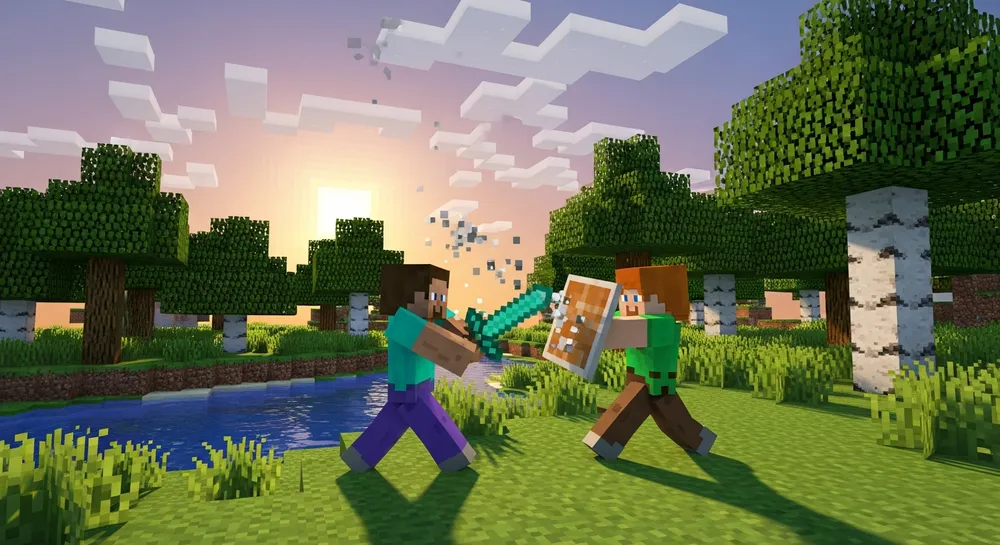
While Minecraft works perfectly well in singleplayer, its true strength often shows in multiplayer. Survival, creative, roleplay, or technical servers all require cooperation, communication, and compromise.
Building a shared base, setting rules, sharing resources, resolving conflicts, these are social skills that Minecraft develops in a natural way. Not through NPC dialogue, but through real interactions with other players. If you betray trust, the community will remember. If you help others, you gain a reputation.
Learning Through Failure, Not Punishment
One of Minecraft’s greatest strengths is its approach to failure. Death in the game hurts - especially when you lose valuable gear - but it’s never final. You can always come back, try again and do better.
This teaches a healthy attitude toward mistakes. Failure isn’t something to be ashamed of, but a part of the learning process. Minecraft shows that setbacks are an inseparable part of growth, and that perseverance matters more than perfection.
In multiplayer, when another player kills you, you lose your gear. That hurts, especially if you were carrying very valuable items. But you can gather the best gear, craft a sword and armor, brew potions, and try to get revenge.
Defeating such an opponent brings not only fun and satisfaction, but is also a perfect example of learning through failure. You can be defeated by someone but later, you might be the one defeating others.
A Game That Grows With You

Minecraft is a title that matures alongside the player. As a child, you might see it as a simple game about building little houses. Over time, you discover redstone mechanics, farm optimization, complex technical projects, and even elements of architecture or urban planning.
It’s a game you can return to at different stages of life and find something new every time. And that’s exactly why it’s so effective at "building character", because it doesn’t force a single path of development, but allows you to find your own.
More Than a Game
Minecraft doesn’t pretend to be an educational program or a life simulator. And yet, by spending time in it, you develop skills that stay with you long after you turn the game off: patience, creativity, responsibility, independence, and the ability to cooperate.
Perhaps that’s why Minecraft has survived for so many years and continues to attract new players. Because beneath the pixels and simple shapes lies an experience that has a real impact on how you think, plan, and create. And that’s something you simply can’t ignore.



No comments yet. Be the first!